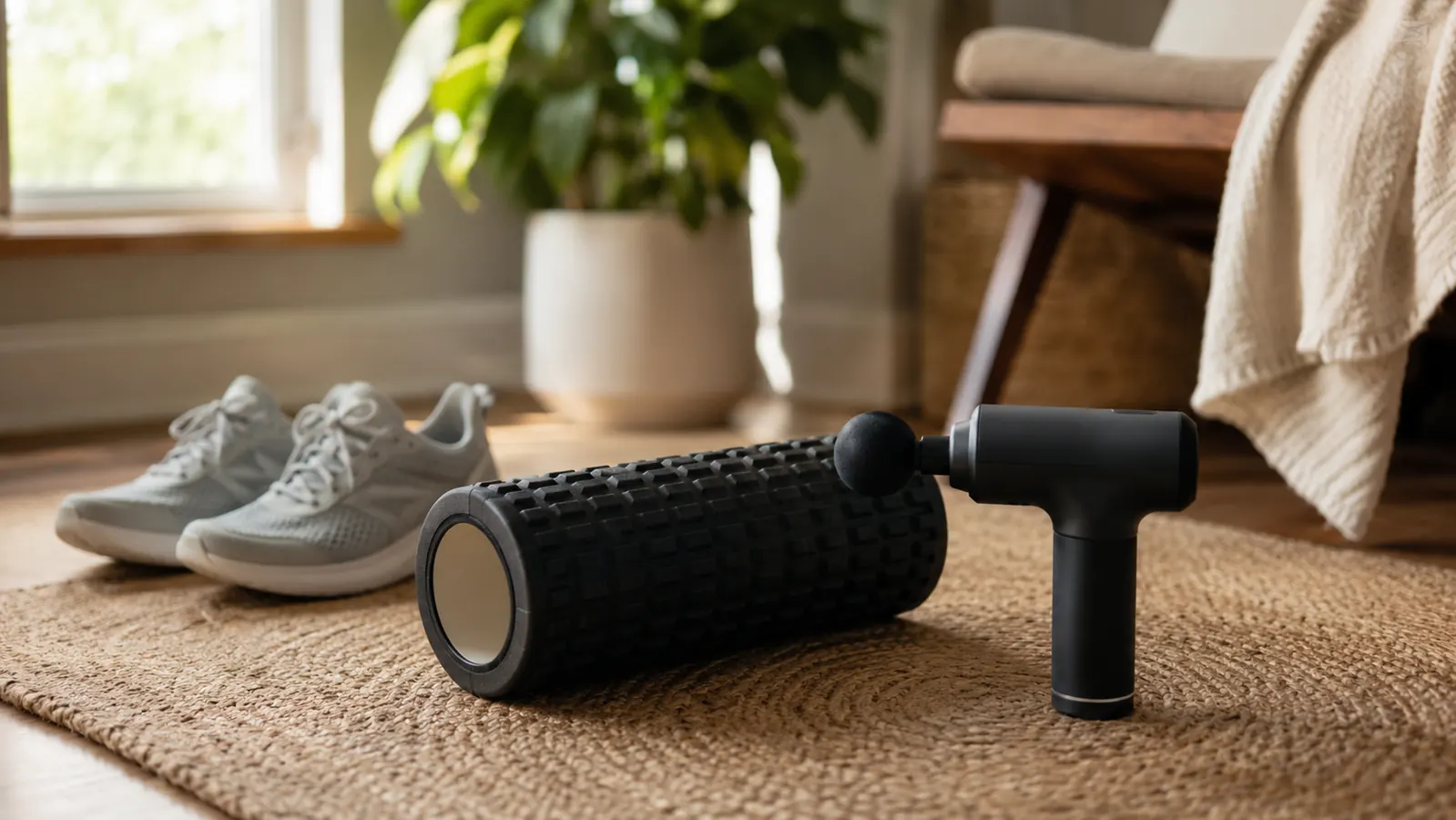
I have been exercising at home every single day for years now. My setup is nothing fancy: a corner of the living room with a thick mat, a set of resistance bands, some adjustable dumbbells that I keep tucked next to the bookshelf, and my TriggerPoint Grid foam roller resting against the wall. That was my whole recovery toolkit for a long time, and it worked fine. Then about six months ago a buddy handed me his massage gun before a workout and said "just try it on your quads for thirty seconds." That single thirty-second experiment planted a question I could not shake. Which tool actually does more for everyday muscle recovery? The foam roller I had trusted through hundreds of workouts, or this expensive buzzing device that everyone on social media was raving about? So I bought my own TriggerPoint Grid and borrowed a Theragun Mini long enough to use both consistently for several weeks, switching back and forth to see which one honestly earned a permanent spot in my tiny home workout area.
The short answer after all that testing is that you probably need both, but if I could only keep one for the way I live and train at home, it is the foam roller without any hesitation. The massage gun does one thing better than anything else I have tried. But the foam roller does almost everything well for a fraction of the cost and with zero maintenance. Let me walk through how they compare in the areas that actually matter.
How I Tested Them Side by Side
I did not set up anything scientific like a lab study. I just used both tools the way a normal person would after real home workouts. After strength sessions with my adjustable dumbbells (squats, presses, rows, the usual). After bodyweight circuits on the mat. After the long kind of day where I had been on my feet cooking, cleaning, transferring my wife from her chair to the couch and back again, carrying laundry up and down the stairs, and then tried to squeeze in a workout at nine at night because it was the only time I had. I alternated which tool I used for recovery each day so I could compare how my legs, back, and shoulders actually felt the next morning. I also tried them for different purposes: pre-workout warmup to get blood moving, post-workout cooldown to ease tightness, and random evening maintenance while watching a movie.
The biggest thing I learned is that these two tools are less like competitors and more like a hammer and a screwdriver. They do different jobs. The massage gun is better at one specific thing. The foam roller is better at almost everything else. The question is which job you need done most often, because that is the tool that should live in easy reach in your workout space.
| TriggerPoint Grid Foam Roller | Percussion Massage Gun | |
|---|---|---|
| Price | A one-time purchase, no recurring costs ever | Several hundred depending on brand and model, replacement head attachments cost extra |
| Ease of Use | Requires positioning body weight against the roller on the floor. Can feel awkward for hard-to-reach spots like the shoulders or glute medius | Point the head at any sore spot and hold. Works on shoulders, neck, glutes, and forearms without contorting yourself |
| Muscle Penetration | Broad pressure that spreads across the whole muscle belly and the surrounding fascia layer. Good for general release | Rapid percussive force that drives deep into specific knots and trigger points. Unmatched for targeted work |
| Portability | Under one pound, no batteries or charger needed, can toss it in any bag at 13 inches long | Weighs two to three pounds, needs charging every few sessions, carrying case is bulky for daily carry |
| Noise Level | Completely silent. Use it while anyone in the house is sleeping without waking them | Motor noise between 30 and 65 decibels depending on speed setting. Audible through a closed door |
| Durability | Solid EVA foam with a molded grid surface. No moving parts, no electronics, no batteries to degrade over time | Battery capacity fades after a year or two of regular use. Motor bearings and plastic housing can fail with heavy or frequent use |
| Best For | Pre-workout warmup, myofascial release across broad muscle groups, improving range of motion, daily mobility maintenance | Post-workout trigger point therapy, deep knots that a foam roller cannot isolate, small hard-to-target muscles like the infraspinatus or scalenes |
Where the TriggerPoint Foam Roller Wins
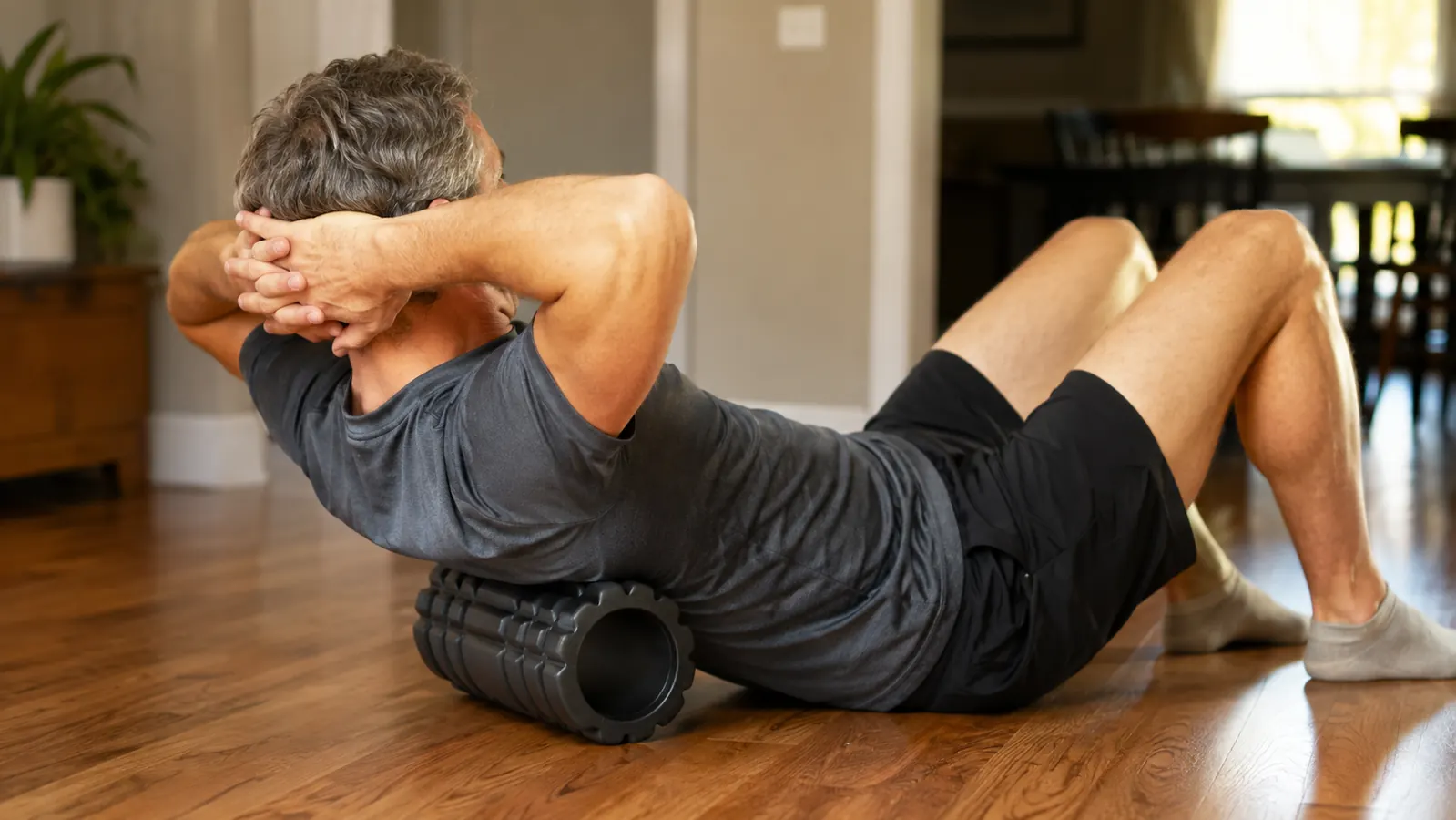
The biggest reason I reach for my TriggerPoint Grid almost every single day is that there is absolutely nothing between me and the work. No battery to check, no charging cable to hunt for, no pairing or speed settings to scroll through. I just bend down, pick it up, drop to the floor, and start rolling. When you are a full-time caretaker with maybe eight minutes between one task and the next, that zero-friction access is the difference between actually doing recovery work and telling yourself you will get to it later. I have done more consistent recovery with this foam roller in the last year than I ever managed with any device that required charging or setup. It is always ready because it was never not ready.
The Grid's multi-density surface design is another reason I prefer it over any massage gun for general use. The foam core is firm with a slightly softer outer layer, and the raised grid pattern creates varying pressure points across the surface as you roll. The high ridges dig into the muscle tissue while the lower channels let blood flow back in, creating a pump-and-release cycle that helps tight muscles loosen up naturally. For opening my thoracic spine after a morning hunched over a laptop doing online work, or releasing my quads after a squat session with the adjustable dumbbells, the broad contact surface of the roller is genuinely more effective than the narrow head of a massage gun. It covers more muscle at once and it does so in a way that feels like a deep stretch rather than a buzzy vibration.
The noise factor matters more than I expected. When I roll out in the evening, my wife is usually resting in the bedroom. The foam roller is completely silent. I can use it while she sleeps, while I watch a show, while I am on a quiet phone call. The massage gun makes enough noise that I feel like I am running a small appliance. You cannot use it in the same room as someone trying to rest, and in my house that makes it a daytime-only tool. That alone cuts its useful hours in half for me.
There is also what each tool asks from your body. A foam roller asks you to lie on the floor and move slowly, which for me doubles as a moment to breathe and reset after a workout. A massage gun asks you to hold a buzzing tool against a spot and wait for it to work. Both get the job done. But the roller gives me a reason to slow down, and on days I am bouncing between caring for my wife and answering online work, that forced pause is as valuable as the muscle release. It is why the Grid stays out in the open and the gun stays in the closet.
Where a Massage Gun Wins
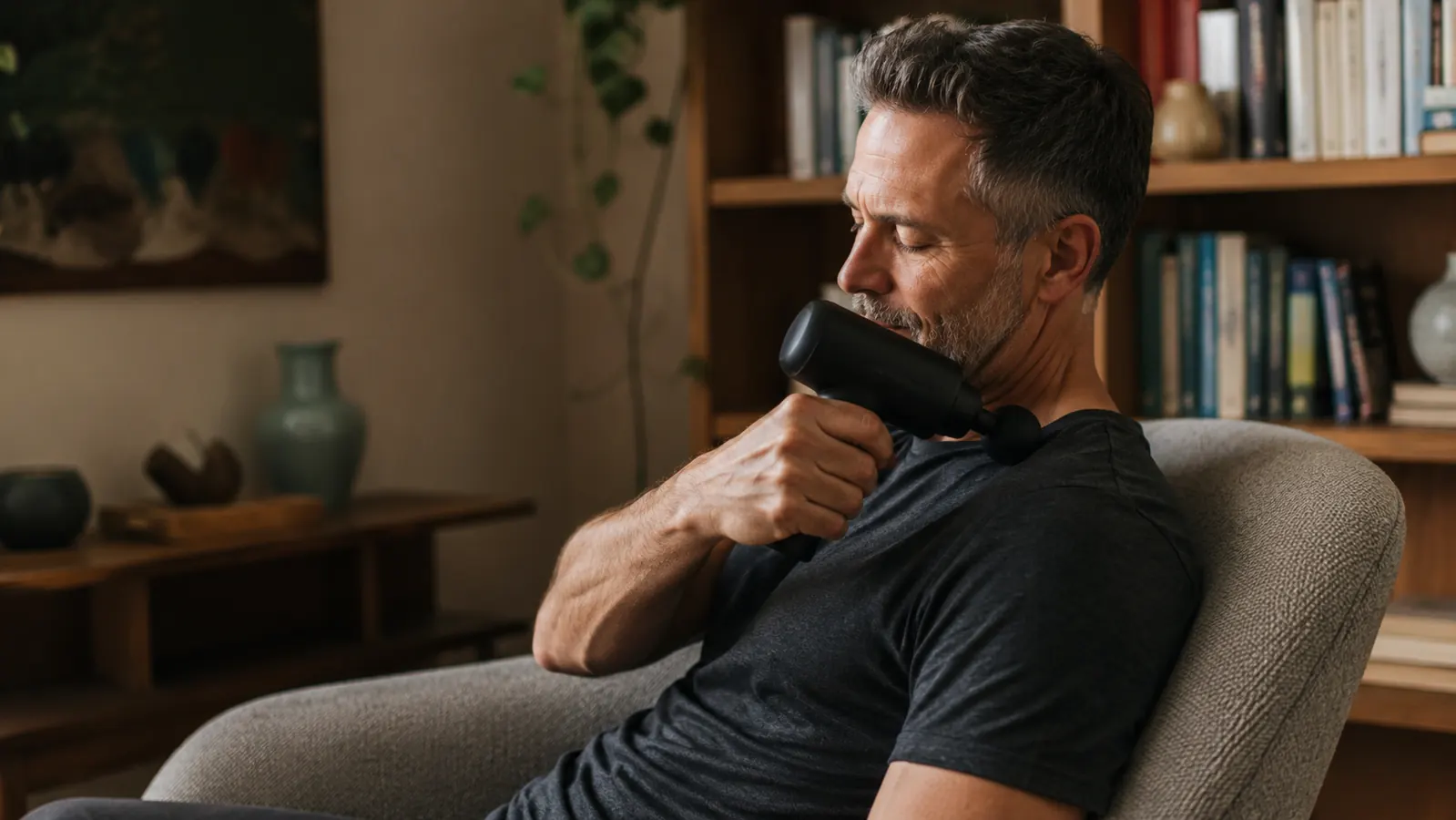
There is exactly one thing a massage gun does that no foam roller can match, and it does it brilliantly. A percussion gun delivers rapid, concentrated force directly into a specific knot or trigger point. The amplitude of each thump drives deep into the muscle tissue in a way that spreading pressure across a foam roller simply cannot replicate. When I have a stubborn tight spot in my upper trapezius from carrying laundry baskets or from the particular leaning posture I use when transferring my wife from her chair to her walker, the foam roller can barely reach that area. I have to lie on the floor at an awkward angle, twist my body in a way that strains my lower back, and I still never hit quite the right spot. A massage gun pressed into that exact knot for thirty seconds at medium speed releases it in a way that twenty minutes of rolling around on the floor cannot touch.
Ease of use is the other advantage that massage gun owners are not wrong about. With the foam roller, you have to get down on the floor, position your body weight, and shift your position to control the pressure. That works fine for legs, glutes, and the middle of the back, but try getting a good release in your anterior shoulder, your forearms, your calves, or the side of your glute medius. It requires real practice and sometimes it hurts more than it helps because you are pressing a bony area against a firm foam surface. The massage gun reaches any muscle you can point it at with zero setup and no floor work. For someone with limited mobility, stiff joints, or back problems that make getting up and down off the floor difficult, that is a meaningful difference that a foam roller cannot address. I have sat on the couch and worked a massage gun into the back of my shoulder and neck while watching a movie with my wife, which is simply not something a foam roller can do.
The one recovery tool I reach for more than any other
After weeks of going back and forth between these two tools, the TriggerPoint Grid foam roller stays in my workout corner and the massage gun sits in a drawer for the rare times I need deep targeted work. If you are building a home exercise setup on a real budget, start here. It does more for less and never needs a charge.
Amazon Check Today's Price on Amazon →Who Should Buy Which
If you exercise at home (or want to start), have limited space, and want the most versatile recovery tool for the least money, buy the TriggerPoint Grid foam roller. It warms you up before a workout, cools you down after, improves your mobility over weeks of consistent use, and never asks for anything in return. It is the single best value recovery tool I have ever owned at a budget price. It replaces a whole drawer of gadgets and it does its job every single time without hesitation. I have used mine nearly every day for months and it looks and feels exactly like the day I bought it. No battery degradation, no worn out motor, no cracked plastic housing. Just the same firm grid surface doing the same job it did on day one.
If you have one specific chronic tight spot that a foam roller simply cannot reach (a shoulder issue that has been bothering you for months, a hip impingement that makes certain exercises painful, a recurring knot in your upper back between your shoulder blades), and you have the budget for a massage gun plus the discipline to keep a device charged and stored properly, then adding one makes sense as a supplement. Use the foam roller for your warmup and general maintenance, then use the gun for that one stubborn spot that needs more force than the roller can deliver. But do not let the social media hype convince you that foam rollers are outdated or that a massage gun replaces everything. The TriggerPoint Grid has been the standard for years for a reason. It works, it lasts, and it fits into real life in a way that a device you have to charge and find drawer space for does not.
For nearly a year now my home recovery routine has been simple and consistent: five minutes on the foam roller after every workout, plus another ten minutes in the evening while I wind down and watch something with my wife. The TriggerPoint Grid lives on the floor in my workout corner, always visible, always ready. That kind of consistency is what actually makes a difference in how I feel over time. It matters more than which tool penetrates deeper or which one costs more. The best recovery tool in the world is the one you will actually use every single day. For me and for the way I live, that is the foam roller.
Start with the recovery tool that never lets you down
The TriggerPoint Grid foam roller has earned its spot in my daily routine through sheer reliability and consistency. At this price, it is the lowest-cost way to improve how your body feels after every single workout. See what it costs today.
Amazon Check Today's Price on Amazon →