
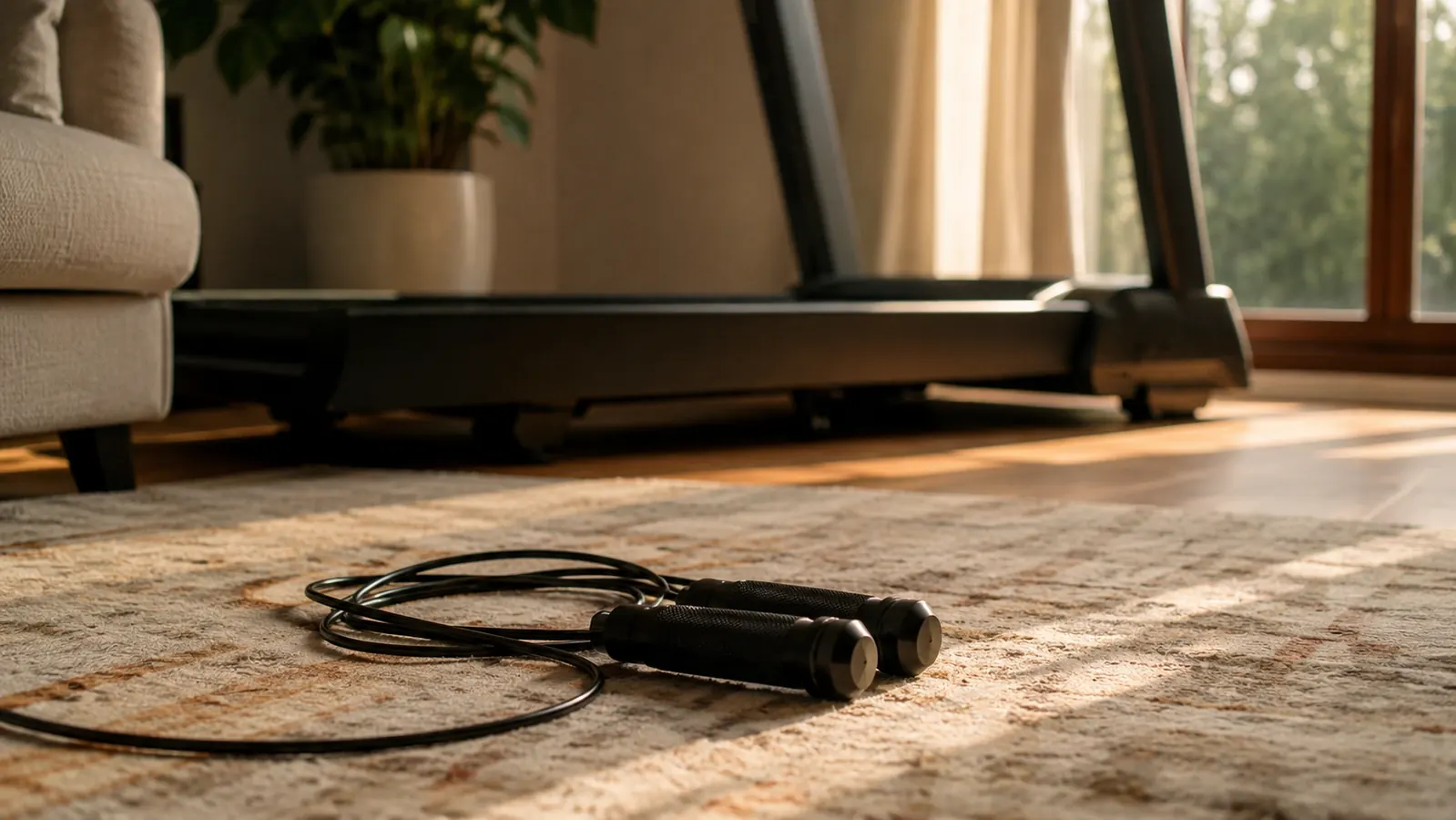
If you are trying to pick between a jump rope and a treadmill for home cardio, I get why it feels like a harder decision than it should be. On one side you have a cheap piece of cable with plastic handles that fits in a drawer. On the other you have what looks like the real deal, a big machine that costs serious money and takes up half a room. It feels like comparing a bicycle to a pickup truck. They both move you forward but they are built for completely different lives.
I have owned both for years. I bought a treadmill first because it felt like the grown-up choice, the thing a serious home exerciser owns. I used it daily for a couple of years before I ever picked up a jump rope. Then I bought a SPORTBIT rope on a whim, and within a month it had replaced the treadmill as my go-to daily cardio. The treadmill is still in the corner of the living room and I still use it, but the ratio shifted hard. I jump rope four or five days a week now and walk on the treadmill maybe twice. That change surprised me, and it is worth walking through why it happened.
The short answer is this. If you want maximum cardio efficiency for the least money and the least space, the jump rope wins. If you need low-impact movement that you can do while your attention is elsewhere, the treadmill wins. The right choice depends on what kind of home exerciser you are, not on which one burns more calories in a lab test. I am going to break down both sides honestly, including where I think the treadmill has a real edge that the jump rope cannot touch.
| SPORTBIT Jump Rope | Home Treadmill | |
|---|---|---|
| Price | Inexpensive for a quality adjustable rope. Replaceable cable if it wears out. | A major investment for something that will last. Cheaper treadmills shake and break. |
| Space Required | Fits in a drawer. Workout happens in a 3x3 foot area you already use. | Dedicated footprint of roughly 6x3 feet plus clearance. Cannot be easily moved. |
| Calorie Burn Per Minute | Roughly 10 to 16 calories at moderate pace. Equal to running an 8-minute mile. | 5 to 8 calories walking at 3.5 mph. Up to 12 at a run, but only if you run. |
| Joint Impact | Medium to high impact. Hard on knees, ankles, and feet if you have joint issues. | Low impact. Walking is one of the safest cardio movements for your joints. |
| Learning Curve | Steep at first. Most adults over 30 need a week or two to find the rhythm. | None. You already know how to walk. Start at zero and increase slowly. |
| Noise Level | Near silent. Light tap on the floor. You can jump while someone naps nearby. | Motor hum, belt friction, foot thuds. Disturbs others in the house. |
| Portability | Fits in a jacket pocket or gym bag. Use it on trips, in parks, in hotel rooms. | Impossible to move. Once placed, it stays until you sell or give it away. |
| Workout Variety | Steady state, intervals, boxer step, double unders, single-leg, footwork drills. | Walk, incline walk, jog, run. Some have preset interval programs. |
Where the Jump Rope Wins
The jump rope wins on cost by a margin that is almost comical. My SPORTBIT rope cost less than a single month of a gym membership. It is less than what I used to spend on replacement laces for my running shoes. It is less than one fast food dinner. And it has lasted me well over a year of daily use without a single problem. The cable shows no fraying, the handles feel solid, and the plastic adjusters still click firmly into place. The treadmill sitting in my living room was not cheap even used, and I still had to replace the motor belt after 18 months for a repair. If you are building a home exercise setup on any kind of budget, the jump rope is the most efficient cardio purchase you can make, full stop.
It also wins on time efficiency in a way that changed how I structure my day. A jump rope workout compresses the same cardiovascular work into roughly half the time of a treadmill walk. Ten minutes of jump rope at a steady pace gets my heart rate up to where a 20-minute brisk walk on the treadmill puts it. When I do intervals, 15 minutes of jumping with short rest periods equals a 30-minute jog in terms of how winded I feel and how much I sweat. For someone like me who works from home and has caregiving responsibilities that break the day into unpredictable chunks, that time compression is the difference between getting cardio done and skipping it entirely. I can bang out a jump rope session in the time it takes the coffee to brew. I cannot do that with a treadmill because by the time I change shoes and get the belt moving, 5 minutes are gone already.
And then there is the space factor, which matters more than most people realize until they live with a treadmill. I do all my jump rope workouts in the living room, roughly the same floor area as a doormat. I push the rug back against the couch and I am ready. The whole setup takes about 10 seconds. The treadmill lives in a corner and it dominates that corner no matter how you arrange the furniture. It is the first thing you see when you walk into the room. When I lived in a smaller apartment a few years ago, a treadmill simply was not an option. There was no corner to give it. A jump rope has never been a space problem anywhere I have lived, and that includes a shared dorm room in my twenties.
The noise factor is one more win that never shows up on a spec sheet. My wife naps most afternoons, and a treadmill running in the next room would be a nonstarter. The SPORTBIT rope barely makes a sound beyond the soft tick of the cable on the floor, so I can get a full workout in while the house stays quiet. That single detail is the reason I actually do my cardio on days when everything else is loud and busy. A treadmill demands a dedicated window of time, a clear corner, and a floor that can take the vibration. The rope just asks for enough space to turn once.
I have learned not to underestimate that quiet, one-spot convenience. When a workout is easy to start and easy to finish, it stops being a negotiation with myself and becomes just something I do before lunch.
I do all my jump rope workouts in roughly the same floor space as a doormat. The treadmill needs a room. That difference matters when you live in a small house.
Where the Treadmill Wins
The treadmill wins on accessibility, and I do not say that lightly. Walking is the most natural human movement there is. You do not need to practice it, you do not need to learn a rhythm, you do not need to coordinate your hands and feet independently. You just step on and move. For someone who is new to regular exercise, recovering from an injury, or carrying extra weight, a treadmill lets you start at the easiest possible level and build up gradually over weeks and months without ever feeling clumsy or frustrated. A jump rope demands a coordination that most adults have not practiced since elementary school, and that initial frustration phase is real. I remember the first week with mine. I tripped over the cable constantly. I whipped my own shins. I felt like I had forgotten how to use my own body. That passes, but it takes time.
The treadmill also wins decisively on joint impact. Jumping puts repetitive impact through your ankles, knees, hips, and lower back with every landing. Even with good form and a padded mat underneath you, that impact accumulates. I feel it in my knees on days when I push beyond 20 minutes of straight jumping. The treadmill, especially at a walking pace, imposes almost no impact at all. Your feet land softly, the belt absorbs some of the motion, and there is no hard stop at the bottom of each step. On days when my joints feel stiff or my lower back is tight from lifting and carrying my wife, I default to the treadmill and I do not feel a shred of guilt about it. Low-impact movement is still movement. It still gets your blood flowing, still burns calories, still keeps your cardiovascular system in good shape.
The other practical advantage of a treadmill, and this one is harder to quantify but equally real, is that you can multitask on it. I walk on the treadmill while I watch a movie with my wife in the evening. I walk on it while I listen to audiobooks or return emails on my phone. With a jump rope you can do nothing else. It demands both hands, your eyes, and your full attention, because the moment you look away the cable hits your ankle and you stumble. That makes jump rope harder to fit into a day where you are also caring for someone else. Sometimes I need 30 minutes of steady movement that does not take my focus away from the rest of the house, and for that the treadmill is the only option.
Start With the Rope That Costs Less Than Lunch
The SPORTBIT Adjustable Jump Rope is the most affordable cardio tool I own. Smooth bearings, a clean fast cable, and it adjusts to your exact height in seconds. At this price, there is no reason to overthink the decision. If you try it and later decide you want a treadmill, you are out pocket change, which is not a real risk.
Amazon Check Today's Price on Amazon →
Who Should Buy Which
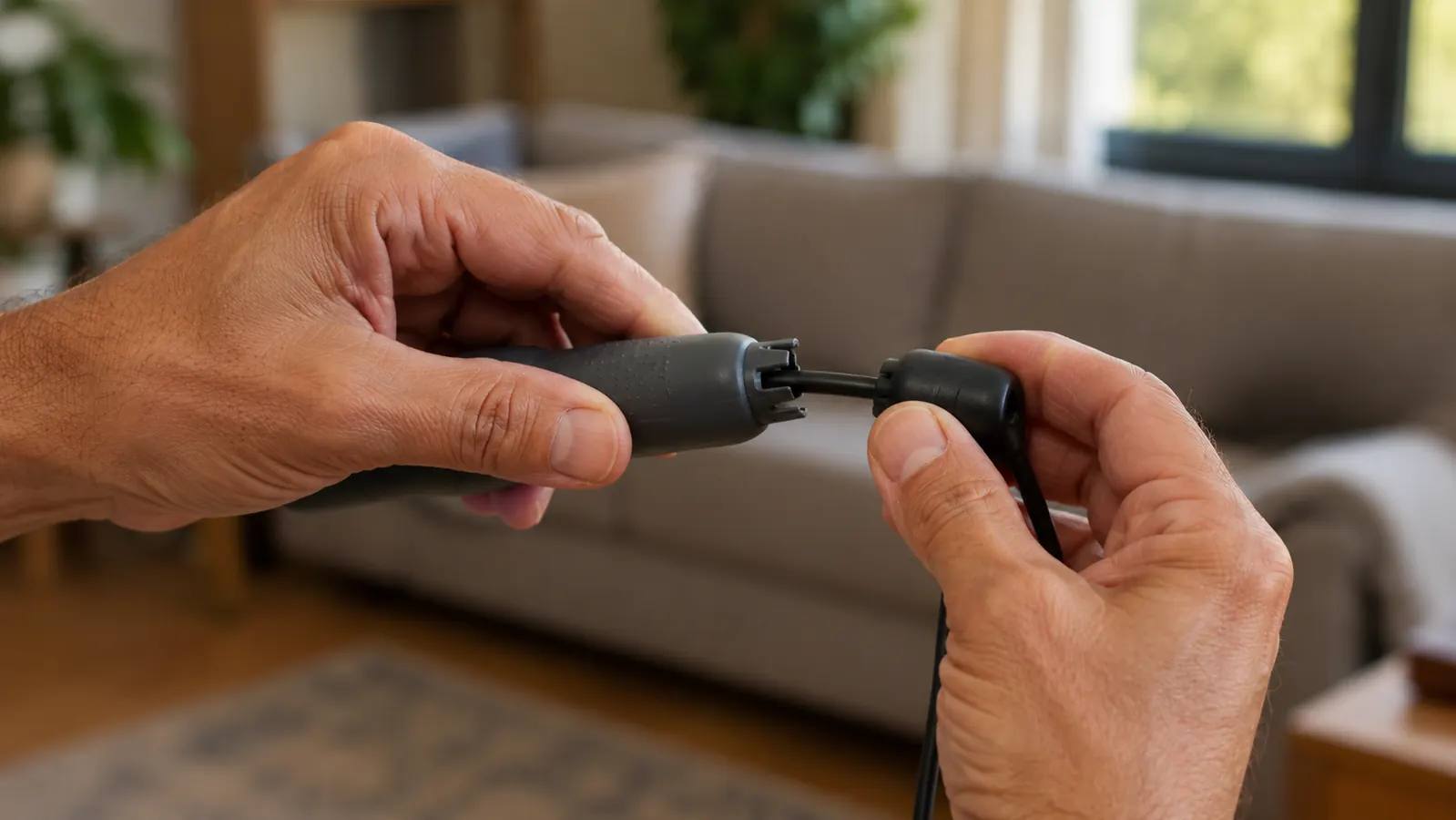
Buy the jump rope if you have limited space, a small budget, and you want the most cardio for your time. Buy it if you travel, if you exercise in the living room because that is the only room available, or if you need a workout you can finish in 10 to 15 minutes between other responsibilities. Buy it if you are reasonably coordinated and do not mind a week of practice where you feel clumsy. The SPORTBIT rope specifically is a solid choice because the cable has good speed, the handles are comfortable in the hand, and the adjustable length means you can dial in the right fit for your height. I am 5'10" and the rope trims down cleanly with the included cutting tool. I have recommended this rope to three friends and all three are still using it months later.
Buy the treadmill if you need low-impact movement that you can do while your attention is on something else. Buy it if you have existing joint problems, if you are recovering from a knee or hip injury, or if you are very new to exercise and need the gentlest possible entry point. Buy it if you have the floor space and the budget, and you know you will use it for walking far more than running. A walking pad or an under-desk treadmill can be a smart middle ground if you want that low-impact benefit without the full-size footprint of a traditional treadmill.
And if you can swing both, they complement each other well. The treadmill lives in the corner for the days when your knees say no and you need to move anyway. The jump rope lives in the drawer for every other day, because it is faster, cheaper, and takes up zero space. They are not competing for a single slot in your home. They serve different versions of the same goal. Keep the one that fits your life right now, and know that the other is cheap enough to add later if you need it.
The Verdict: Start With the Rope
A budget jump rope gets you 90 percent of the cardio benefit of a pricey treadmill at zero percent of the space cost. Get the SPORTBIT rope today, try it for two weeks, and see how it fits your home routine. If it works, you just saved yourself a lot of money. If it does not, you lost the cost of lunch.
Amazon Check Today's Price on Amazon →