There was a stretch of months after my wife's surgery when I thought my fitness days were over. Not because I did not want to exercise. I wanted to. But I could not leave the house for more than twenty minutes at a time, and the idea of driving to a gym or even going down to the basement for a full workout felt like a luxury I no longer had. The truth is, when you are a caretaker, your time stops belonging to you. It belongs to someone else's needs, someone else's schedule, someone else's doctor appointments. I thought I had to choose between being fit and being there for her. Then I realized I could do both.
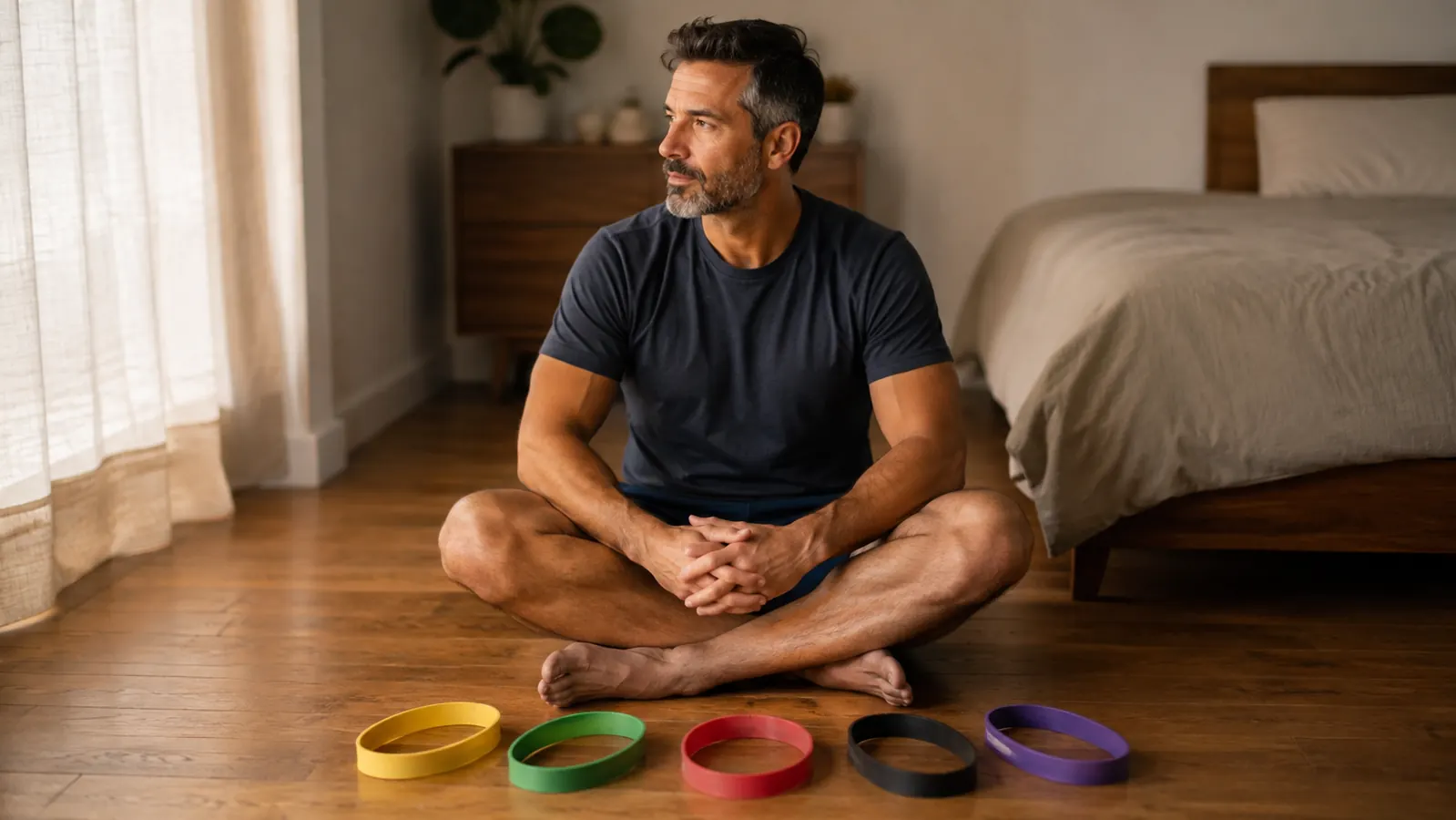
That realization came in the form of a small cloth bag with five colored bands in it. The Fit Simplify Resistance Loop Bands cost me less than a pizza and took up about as much space as a sandwich. But they gave me something I had lost: the ability to move my body without leaving the room where my wife was resting. No commute, no changing clothes, no waiting for a machine to open up. I just grabbed the right color band and started moving. Here is the exact routine I built around them, step by step, so you can build yours too.
The Bands That Fit Into a Caretaker's Life
The Fit Simplify set of five bands gives you light through extra-heavy resistance levels. They are small enough to keep in a bedside drawer and priced low enough that you can grab a set without thinking twice. I have been using mine daily for months without any signs of wear.
Amazon Check Today's Price on Amazon →Step 1: Place Your Bands Where You Cannot Miss Them
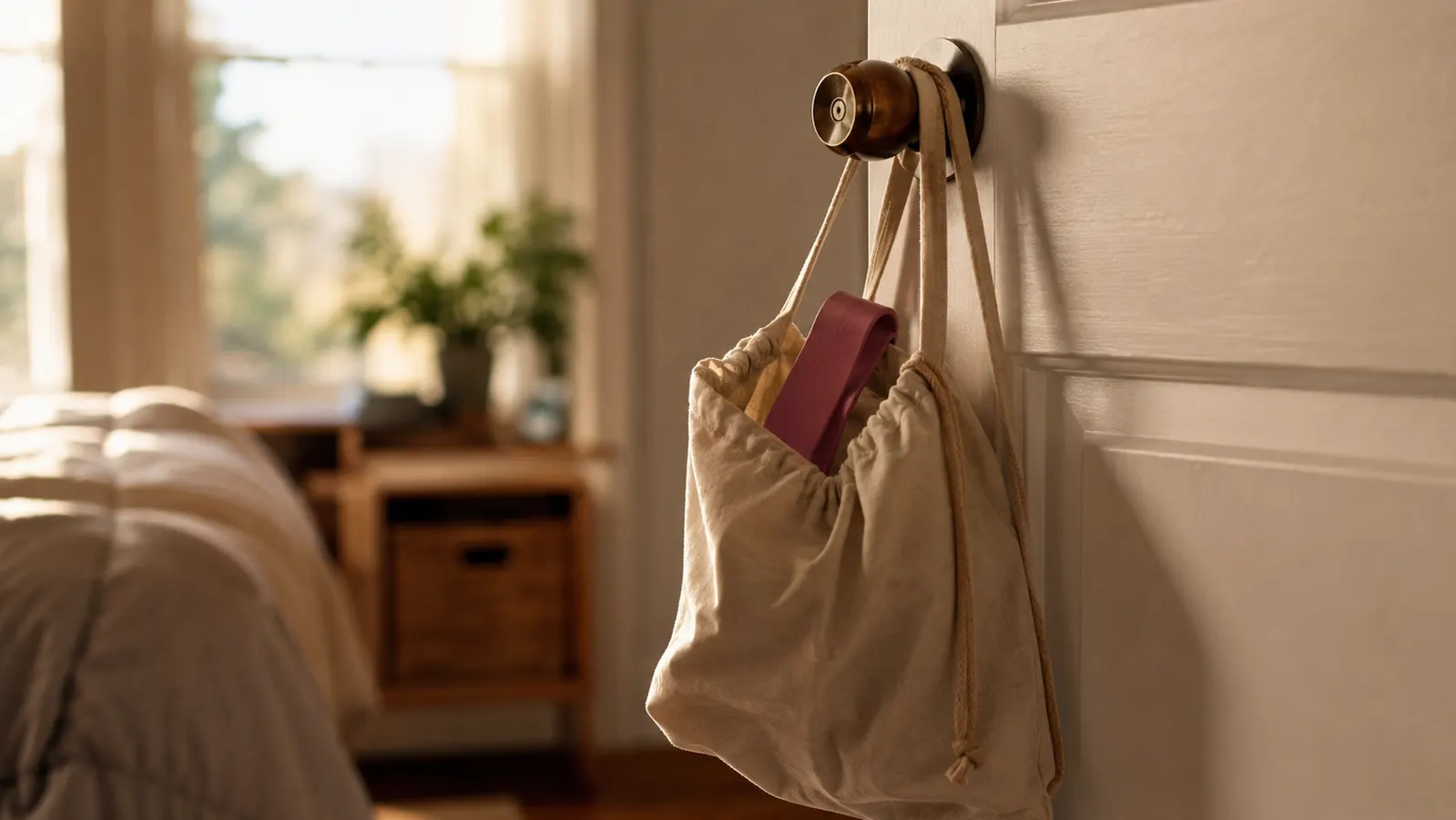
I kept my Fit Simplify bands in a kitchen drawer for the first two weeks and used them exactly zero times. Out of sight, out of mind. The fix was simple. I hung the carry bag on the doorknob of the bedroom where my wife and I spend most of our day. When I walk past that door, I see the bands. When I see the bands, I do a set. It sounds almost too simple to matter, but this one change turned my hit rate from zero workouts a week to five or six.
Your environment is more powerful than your willpower, especially when you are tired from caregiving. Put the bands somewhere you cannot miss them. On a nightstand. On a dresser handle. On the bathroom towel rack. Just get them out of the drawer. I also keep the instruction guide that came with the bands tucked into the drawstring. On days when I am too tired to remember what exercises exist, I flip through it. It shows basic moves with simple line drawings, no video needed, no scrolling on a phone. That small booklet has rescued more workouts than any app ever did.
One more thing on placement. Keep the bag open. If the drawstring is cinched tight, you will have to stop and untie it every time you want a band. That extra two seconds is enough friction to skip a set when you are already tired. Leave the top loose so you can reach in and grab the band you need without breaking your rhythm.
Step 2: Start Each Session With a Warm-Up While You Check In
Before I touch a single exercise, I sit on the edge of the bed and do arm circles and ankle rolls for two minutes. During those two minutes, I ask my wife how she is feeling, if she needs anything, and what her pain level is. This does two things. It warms up my shoulders and hips so I do not pull a muscle. And it lets me address her needs before I start moving, so I can focus on the workout instead of wondering if she is okay.
I use the lightest band from the Fit Simplify set for this warm-up. It is the thin yellow strip marked extra light. I loop it around both wrists and, as I circle my arms forward and backward, I pull outward against the band. This activates my upper back and rear shoulders before I do any real pulling or pressing. It takes ninety seconds and doubles as a mobility drill. My shoulders pop and crack less now than they did when I was twenty-five, and I credit this warm-up for most of that improvement.
The warm-up has become part of our morning routine. She expects the question now. It is a small moment of connection before I shift into my own movement, and it reminds me that staying fit is not something I do despite being a caretaker. It is something I do as part of being one. A caregiver who cannot lift, carry, or move well is not much help to anyone.
Step 3: Pair One Upper Body Move With One Lower Body Move
I do not have time for a full split routine with separate arm day and leg day. I do not need one. I pick one upper body exercise and one lower body exercise, do them back to back, and rest for sixty seconds. That is one circuit. I try to get three or four circuits in before something pulls me away. Some days I get eight circuits. Some days I get two. Both count.
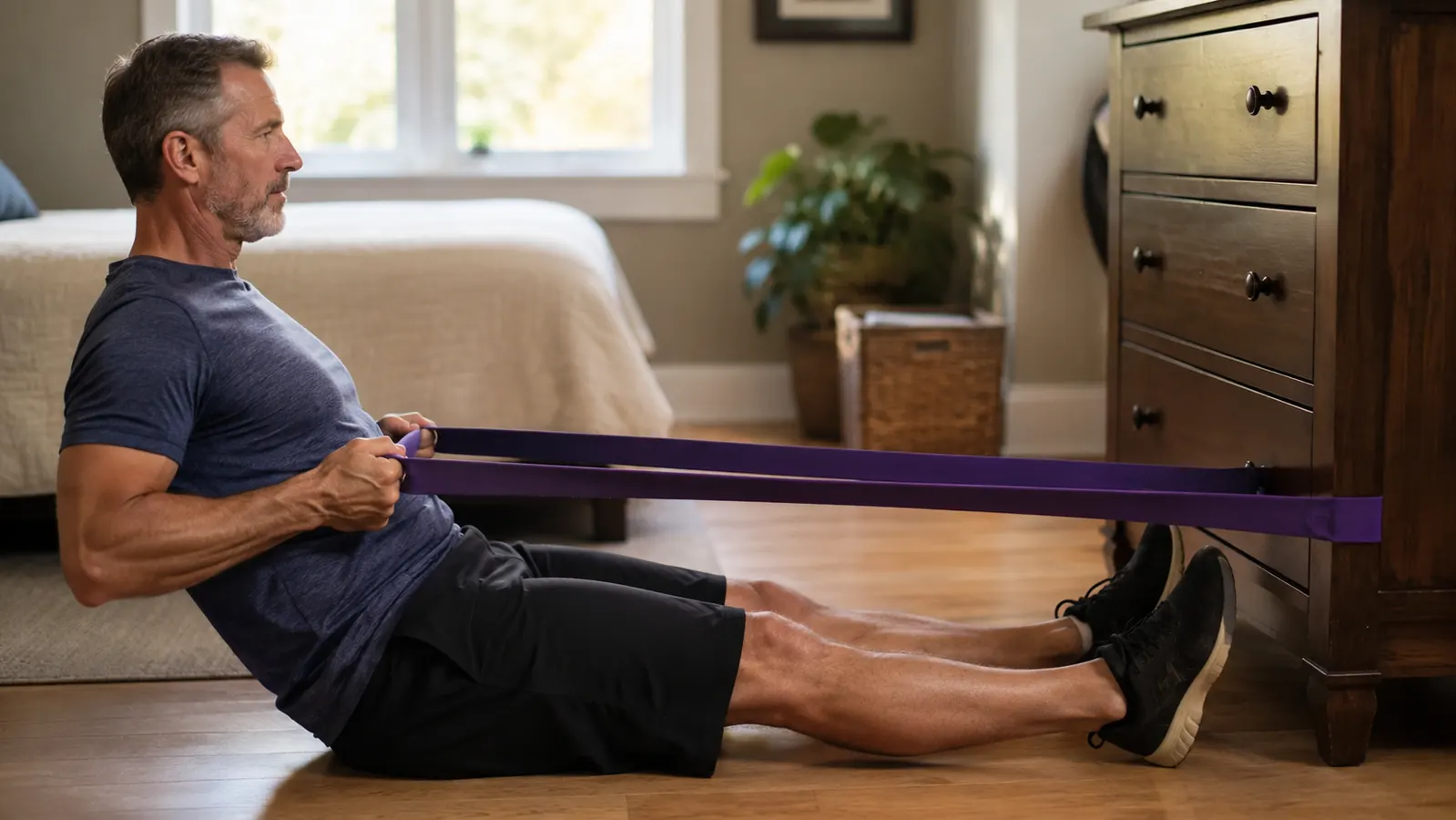
My go-to upper body move is a seated row. I loop the medium resistance band, which is the red one from the Fit Simplify set, around the leg of my heavy wooden dresser. I sit on the floor with my legs straight out, grab one end of the band in each hand, and pull toward my belly button. I squeeze my shoulder blades together at the end of each rep, then release slowly. That one move hits my back, biceps, and rear shoulders. Twelve to fifteen reps per set, three sets per circuit.
For lower body, I do banded squats. I step on the center of the extra heavy band, the blue one from the set, and bring the handles up to my shoulders. I squat down like I am sitting in a chair, keeping my chest up and my knees tracking over my toes. Twelve reps. By the end of two circuits, my legs are shaking and I am breathing hard. And I have not left the bedroom. I have not missed a single moment of my wife's care. That is the whole point.
Step 4: Keep Your Rest Period Active
When I am resting between circuits, I do not just sit there staring at the wall. I grab the lightest band again and stretch it between my hands. I pull it apart over my head, then behind my back, then in front of my chest. This keeps my shoulders mobile and my blood flowing without adding fatigue. It also gives me something to do with my hands while I catch my breath.
The Fit Simplify bands are coated in a fabric blend that feels soft against the skin. That matters more than you think when you are doing forty or fifty reps across a session. I have used bare rubber bands before that left red marks and pinched hairs. These do not. The rubber core gives the resistance, and the fabric wrap keeps it comfortable. I can hold the band against my bare palms without any biting or slipping.
Another active recovery move I like: step on the center of a medium band, cross the handles in front of you, and pull up toward your chin. This hits the traps and upper back gently without loading your lower back. It is not a heavy move, but it keeps the blood moving between circuits. Do this for sixty seconds between sets and your entire session becomes more efficient. You get more work done in less time, which is the whole goal when your time is not your own.
Step 5: End Every Session With a Band-Assisted Stretch
The last thing I do every workout is a hamstring stretch with the extra light band. I lie on the floor, loop the band around the ball of my foot, and pull my leg gently toward my chest. I hold for thirty seconds, switch legs, and repeat. Then I do the same for my quads by lying on my stomach and pulling my foot toward my glutes with the band around my ankle.
Stretching with a band is different from stretching without one. The band gives you resistance on the way in and support on the way out. You can go deeper without overstretching because the band catches you at the end range and prevents you from bouncing. This part takes about four minutes total, and it is the reason I wake up the next day without stiffness despite being in my forties and sleeping on a mattress that needs replacing.
I finish every session by lying flat on the floor for two minutes with the extra light band resting across my eyes. The fabric is soft and dark, and the gentle pressure is calming. It is the only two minutes of my day that are completely quiet and completely mine. Then I get up, put the bands back in the drawstring bag, hang them on the doorknob, and get back to the day.
What Else Helps When You Are Exercising as a Caretaker
A few things I have learned along the way. First, do not wait for a block of free time. It will not come. Do your sets when you can. Two minutes here, three minutes there. It all adds up. Second, involve the person you are caring for if they are able. My wife cannot exercise with me, but she counts my reps. It gives her something to focus on and makes the workout feel like a shared activity instead of something I am doing apart from her.
Third, keep your expectations low and your consistency high. I do not try to hit a personal record every week. I try to move my body every single day. That is the win. Some days I do five circuits of heavy resistance. Some days I just stretch with the lightest band. Both are better than the alternative, which is doing nothing and waking up stiff and weak and resentful.
Fourth, pay attention to what your body tells you after each session. I keep a small notebook next to the band bag and jot down which resistance level I used and how my joints felt afterward. After a few weeks, I noticed my right shoulder felt better after seated rows and worse after overhead presses. That changed which exercises I prioritized. You will not spot those patterns unless you write them down.
The Fit Simplify bands make this possible because they remove every excuse. No setup time. No noise. No space required. Just five bands in a bag and a doorknob to hang them on. If you are caring for someone and you think you cannot stay fit, start with step one. Put the bands where you can see them. The rest will follow.
I thought I had to choose between being fit and being there for her. Then I realized I could do both with a set of bands that fit in my pocket.
Start Moving Today With the Same Bands I Use
The Fit Simplify set costs pocket change and takes up less space than a pair of socks. Five resistance levels, a carry bag, and an instruction guide. No gym, no commute, no excuses. I have been using mine for months and they still look and feel like new.
Amazon Check Today's Price on Amazon →