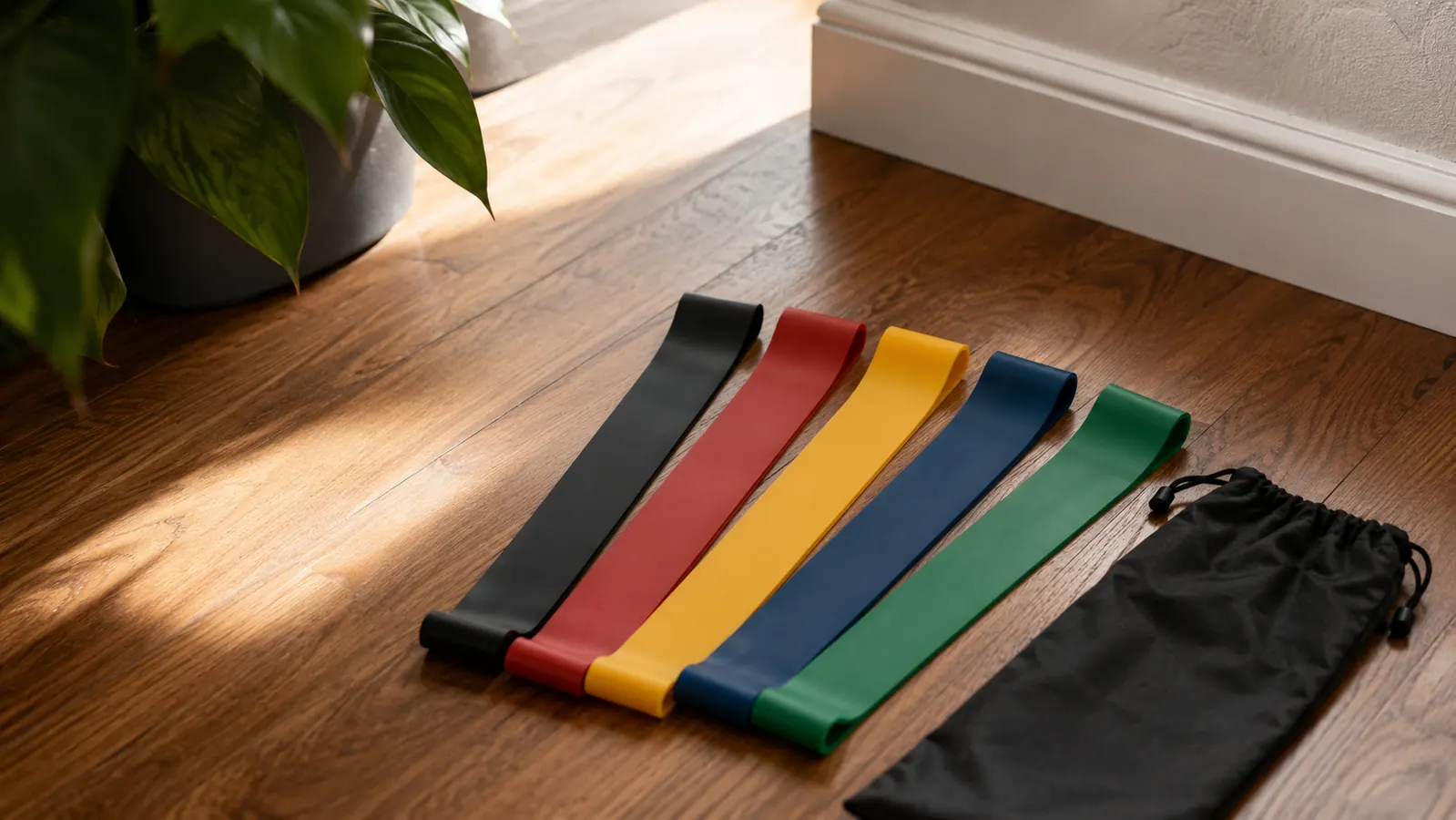
I have a confession to make. I bought my first set of resistance loop bands about seven years ago, used them for maybe two weeks, and then they lived under my bed until I moved out of that apartment. The bands were fine. The problem was that I had no plan for them. No structure, no specific goals, no idea how to turn a handful of latex loops into an actual workout. So when I picked up the Fit Simplify set, I decided to do the opposite. I would test each band with specific exercises. I would measure what happened over time. And I would figure out whether a five-band set that costs less than a takeout lunch is a legitimate piece of home exercise equipment or just another impulse buy dressed up in a carry pouch.
The numbers on the Amazon listing are hard to ignore. Over 136,000 customer reviews and a 4.7-star average. That is the kind of volume that usually means a product is either genuinely excellent or so cheap that nobody bothers returning it. I wanted to know which one was true. And more than that, I wanted to find the things the five-star reviews do not mention. The gradual stretch that nobody talks about. The exercises these bands are actually bad at. The small design choices that matter more than you expect. This review is for everyone who reads Amazon reviews and always wonders what the people who did not give five stars would say.
The Quick Verdict
Fit Simplify's bands deliver real value for the price, but the five-star reviews smooth over some honest shortcomings. The bands lose tension over months of use, the lightest band is borderline useless for anyone past a beginner level, and the carry pouch zipper is the first thing to fail. For most home exercisers, this set is still a strong buy. Just know what you are getting into.
Amazon Check Today's Price →Start with the set over 136,000 people already bought
At today's price for five bands plus a carry pouch and guide, the risk is almost zero. If resistance bands turn out not to be your thing, you are out less than a fast-food dinner.
Amazon Check Today's Price on Amazon →How I Tested These Bands
I tested the Fit Simplify bands as part of a structured home workout routine over several months. I worked out three to four times per week, running through a circuit of upper body pushes and pulls, lower body compound movements, and mobility work. I used every band in the set across multiple exercises to gauge consistency of resistance, durability under repeated stretching, and how the bands performed at different points in their lifespan.
I paid attention to specific things that most casual reviews skip. How much does the resistance change when a band is stretched to 50 percent versus 100 percent of its length? Does the band return to its original shape after being held at full stretch for 30 seconds? Do the resistance levels between bands make clear, useful jumps or are they too close together to matter? I also tracked how the bands felt after repeated use to see if they lost elasticity the way cheaper latex products do.
I did not use any equipment beyond the bands themselves. No door anchors, no handles, no ankle straps. The bands come with nothing extra, and I wanted to evaluate exactly what ships in the box. If a door anchor or handle set is required to make these useful, that is a mark against them at this price point.
The Five Bands: Where the Sizes Actually Land
Fit Simplify does not publish exact poundage ratings for their bands, which is the first thing I noticed. Most competing sets tell you roughly how many pounds of resistance each band provides at a given stretch length. Fit Simplify just labels them extra light, light, medium, heavy, and extra heavy. Based on feel, the range is probably about 3 to 5 pounds on the lightest end and maybe 25 to 30 on the heavy end at full extension. But the bands produce almost no resistance when they are only stretched a little. The resistance ramps up sharply in the last few inches, which means you have to stretch each band close to its limit to feel real work.
Here is the honest part. The extra light band is nearly useless for strength training. It provides 2 to 3 pounds of resistance at full stretch. For context, a can of soup is about one pound. You can pull that band for 50 reps and barely feel it in your muscles. It works for warm-up shoulder rotations and very gentle stretching, but calling it a resistance band for exercise purposes is generous. The jump from the light band to the medium band is the most useful transition in the set. The jump from the medium to the heavy is noticeable but reasonable. And the jump from the heavy to the extra heavy is the biggest gap in the set, which means you will find yourself in a spot where the heavy feels too easy and the extra heavy feels too hard.
Durability: What Happens to Latex Over Time
The bands are made from natural latex and they feel good out of the package. Dense, smooth edges, consistent thickness around the loop. No rough seams or leftover molding flash. But latex has a known lifespan, and Fit Simplify does not do anything special to extend it. After regular use, I noticed that the medium band started to feel slightly looser than it did when new. Not dramatically so. Not snapped or torn. Just a few percent less resistance at the same stretch length. The light band showed the most change because it is the thinnest and gets stretched the most relative to its thickness.
This is the thing I do not see mentioned often in reviews of resistance bands. They all lose tension gradually. It is not a defect. It is the physical property of latex under repeated stress. But it matters because it means you cannot rely on a band to deliver the same resistance over months the way you can with a dumbbell. A 20-pound dumbbell is 20 pounds forever. A band that gave you a good workout in January might feel noticeably easier by June. The good news is that you can compensate by choosing a thinner starting point on the band or wrapping it around your hand to shorten the effective length. The bad news is that you have to think about it, and many people will not realize their bands are getting easier and will think they are getting dramatically stronger.
I did not have any bands snap or tear during my testing. The construction is solid and the material thickness feels appropriate for the claimed resistance levels. The carry pouch zipper, however, is the weak link. The drawstring closure on the pouch works fine and has held up well. But the small zippered pocket on the front of the pouch started catching and skipping teeth after about a month. I stopped using that pocket. Not a dealbreaker, since the main compartment works fine, but it is the kind of detail you notice over time.
What I Liked
- Genuinely affordable at today's price for a five-band set
- Smooth, well-finished latex edges that do not dig into hands
- Five resistance levels cover most home exercise needs
- Portable in the included carry pouch with minimal space required
- Instruction guide includes actual workout routines, not just pictures of bands
- No bands snapped or tore during months of regular testing
- Resistance curve at full stretch provides a real challenge, especially on the heavy and extra heavy bands
Where It Falls Short
- Bands lose tension gradually over months of regular use, especially the lightest one
- Extra light band provides almost no usable resistance for strength work
- No exact poundage ratings printed on the bands or packaging
- Latex material means anyone with a latex allergy cannot use them safely
- Carry pouch zipper is flimsy and started failing within a month
- Gap between heavy and extra heavy bands is bigger than the other transitions
- No door anchor or handles included for expanded exercise options
A 20-pound dumbbell is 20 pounds forever. A band that felt challenging in January might feel noticeably easier by June. The five-star reviews do not tell you that part.
Which Exercises Work Best with Loop Bands
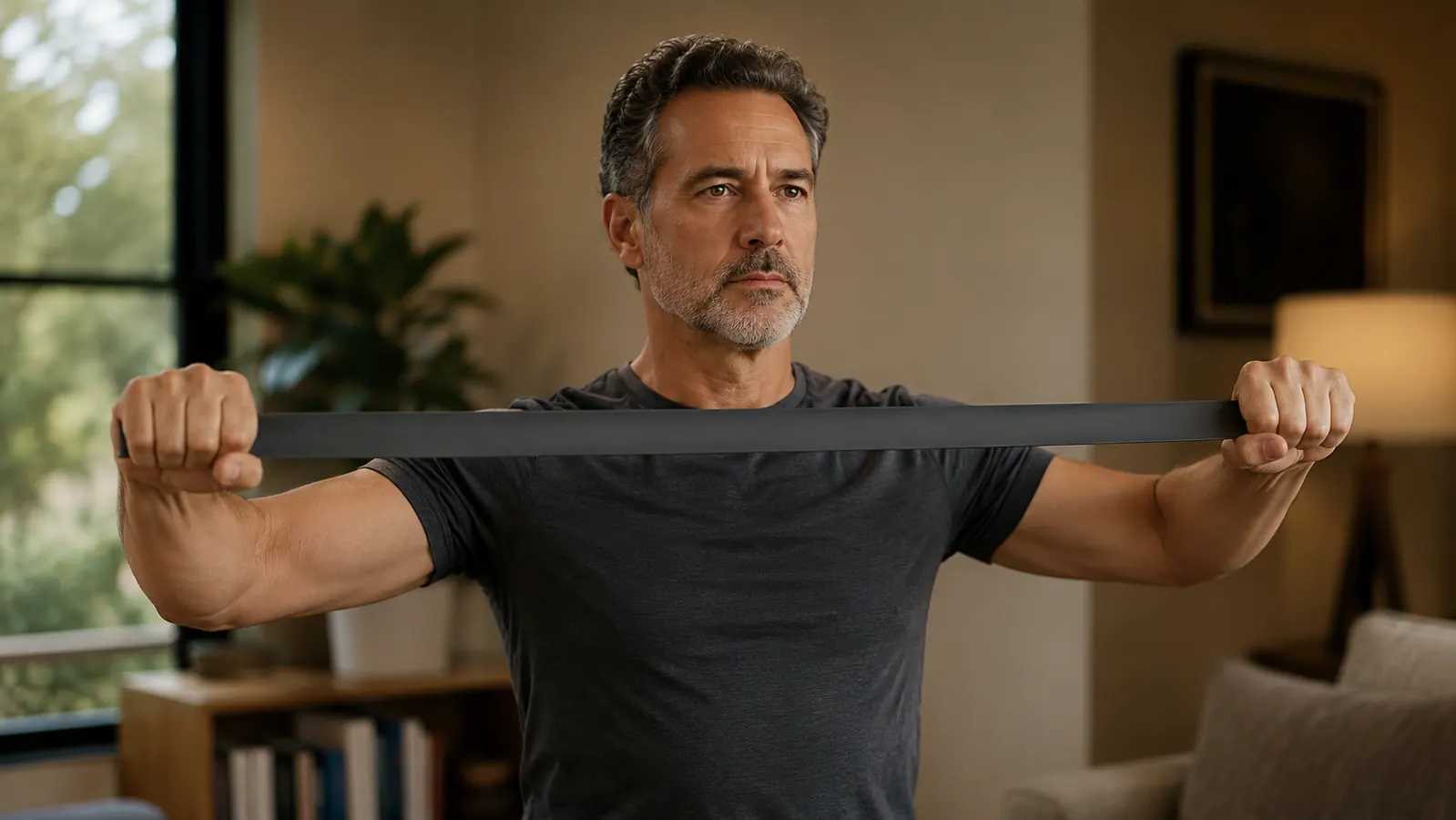
Some exercises are great with loop bands. Others are frustrating. Here is the honest breakdown based on my testing. The seated row is excellent. Loop the band around your feet, sit on the floor with your legs straight, and pull the band toward your waist. The resistance curve loads the contraction at peak pull, which is exactly where you want it. The overhead press works well if you step on the center of the band and press upward from shoulder height. The band pulls hardest at the top of the movement, which is harder than a dumbbell overhead press where the top is actually the easiest part. Glute bridges and hip thrusts also work well because the band wraps around the hips and loads the movement through its entire range.
Here is what does not work as well. Chest presses are awkward without a stable anchor point. You can do them lying on your back with the band wrapped around your upper back, but the band wants to slide toward your neck and you have to hold it in place. Bicep curls with a loop band require stepping on the band and curling upward, but the band rolls on your foot and the resistance is too low at the bottom of the curl where you actually need it. Deadlifts are not practical at all because the band bottoms out before you reach the standing position. These are the exercises people try to do with loop bands and wonder why they do not feel right.
The Instruction Guide: Better Than Expected, Not Perfect
The set includes a small printed guide showing exercise illustrations. I expected a throwaway pamphlet with generic drawings. What I got is actually a structured workout guide with about 20 different exercises organized into warm-up, main, and cool-down sections. The illustrations are clear and the descriptions are short enough to follow without studying them. For someone who has never used resistance bands before, this guide is genuinely useful. It shows you proper form for each movement and suggests how many sets and reps to do.
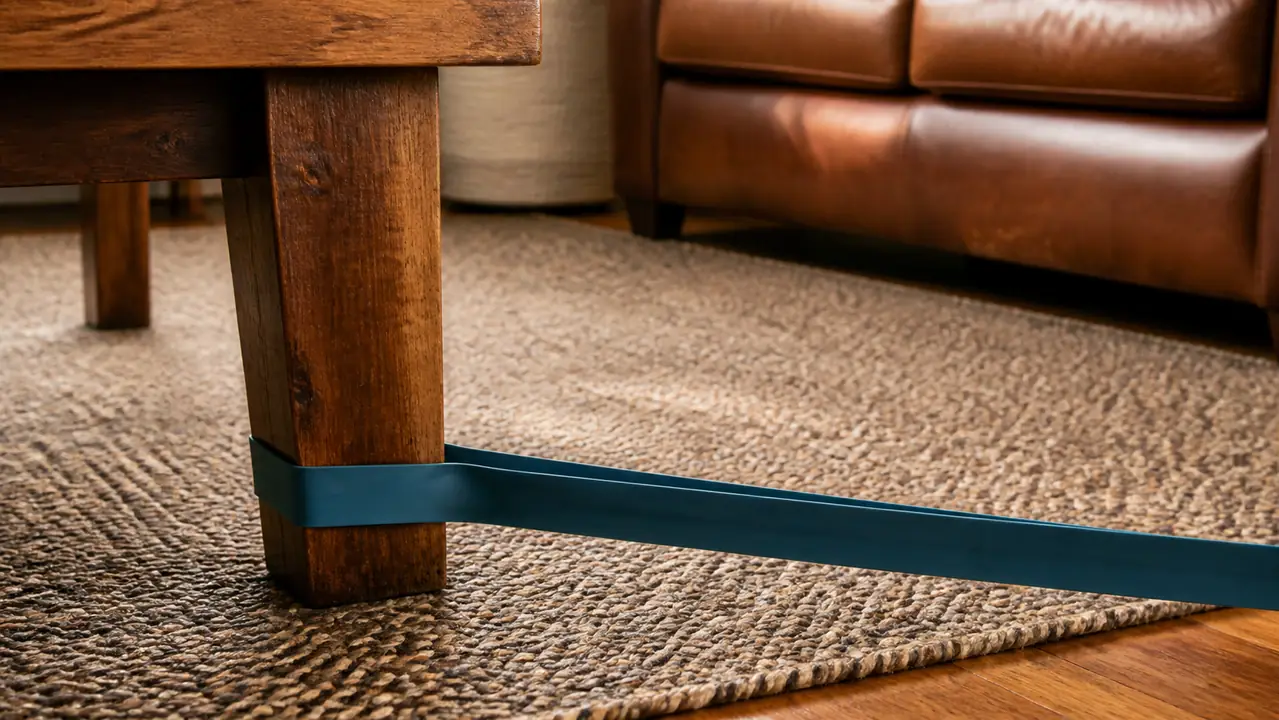
The drawback is that the guide is printed on thin glossy paper that curls at the edges after a few weeks of being handled. The font is small and the layout crams too many exercises onto each page. And the guide assumes you have a door anchor for several of the exercises, which is not included in the box. If you buy just the bands expecting to follow the guide exactly, you will need to buy a door anchor separately. That is a small frustration but worth knowing before you open the package expecting a complete ready-to-go system.
Who This Is For
These bands are for anyone who needs a no-commitment way to start resistance training at home with limited space and a limited budget. Beginners will get the most value because the resistance range is well-suited to building foundational strength. People who travel frequently will appreciate how little space the pouch takes in a suitcase. Older adults and people recovering from injuries will find the light and medium bands useful for gentle strengthening and mobility work. And anyone who has ever bought a piece of exercise equipment, used it twice, and felt guilty about the cost will appreciate that this set costs less than most mistakes.
Who Should Skip It
If your primary training goal is measurable progressive overload with consistent resistance, resistance bands in general will frustrate you, and these are no exception. The gradual loss of tension and the variable resistance curve make it hard to track linear progress the way you can with dumbbells or a barbell. If you need to add weight in small, repeatable increments, bands do not provide that. Also, if you have a latex allergy, these bands are not safe. The material is natural latex and direct skin contact can cause a reaction. And if you are an experienced lifter looking for serious resistance to challenge well-developed muscles, the heaviest band will probably top out on you within a few weeks.
The Value Question
At today's price, the Fit Simplify set is an easy recommendation for most people despite the limitations I have laid out. A five-band set that covers warm-up through moderately challenging resistance, with a carry pouch and a usable instruction guide, for pocket change. The value proposition is straightforward. You are not buying the best resistance bands ever made. You are buying a set that works well enough to tell you whether resistance band training fits into your life. If you use them for a few months and decide you want something heavier or more durable, you have lost almost nothing and gained valuable information about what you actually need.
The larger question is whether resistance bands as a category make sense for your goals compared to other home exercise options. For some exercises and some people, bands are clearly better than the alternatives. For others, they are clearly worse. That is the real answer that the five-star reviews skip. The bands are not a miracle tool that replaces every other piece of gym equipment. They are a specific tool for specific jobs, and within their lane, they perform well. The Fit Simplify set gives you a cheap, honest entry point to figure out whether that lane is yours.
For me the honest bottom line is this. The Fit Simplify set removes the two biggest reasons home exercise fails: cost and setup time. There is no assembly, no subscription, and no dedicated corner of the house that has to stay clean. You open the bag, you loop a band, and you start. When a piece of equipment is that easy to reach for, you actually reach for it, and that consistency matters more than a marginal difference in resistance curve. It is why the set stays in my rotation months after the novelty wore off.
See today's price and decide for yourself
The honest truth is that these bands work well for most home exercisers but have real limitations. The only way to know if they are right for you is to try them at this low-risk price point.
Amazon Check Today's Price on Amazon →